Malorie
Bird BoxMalorie is the novel’s central survivor and caregiver, a woman compelled to make life-sustaining decisions in a world where sight itself can be dangerous. Her story joins private grief to practical work: she mourns Shannon, prepares for childbirth without medical help, trains children to survive blindfolded, and eventually leads them downriver to a community where she can choose to see again. The novel measures her change through what she can carry, teach, and endure, not through any simple disappearance of fear.
Identity and Background
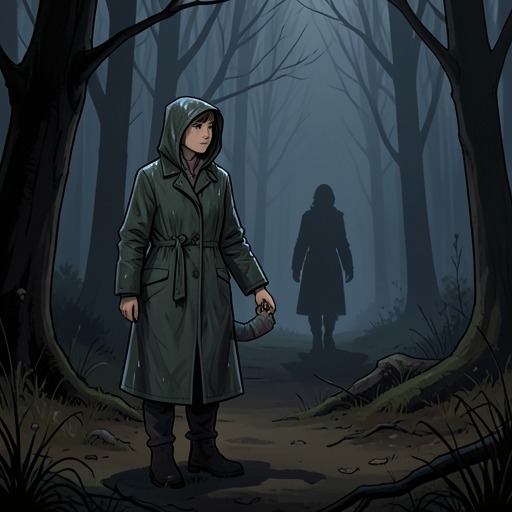
The narrative first places Malorie in a kitchen at daybreak, trembling and thinking about the uncertain light beyond the drapes. This interior moment establishes a governing tension: she must interpret a dangerous world while restricting the sense that would ordinarily make it legible. The novel repeatedly returns to her body and its responses—fatigue, pain, and careful movement—as practical facts of survival rather than background details.
The crisis is also bound to losses that precede the river journey. Malorie discovers her sister Shannon dead in the bathroom and tries to summon help, but the police and her parents do not answer. She reaches for the front door, only to find that she cannot make herself turn the knob. The scene links grief to the larger collapse of ordinary safety: the familiar route to help no longer works, and Malorie is left facing the consequences alone.
Shannon is not the only person whose death shapes Malorie’s understanding of the catastrophe. Tom tells her that his eight-year-old daughter Robin died by suicide; he cannot know whether Robin saw outside or acted from her own despair. Malorie holds Tom as he speaks, but he does not cry. He turns instead to marking paper. This disclosure gives Malorie a close view of how the crisis has entered a family’s most intimate life, while also foreshadowing the restraint and purposeful activity that will become central to her own way of enduring loss.
Preparing to Leave and Survive
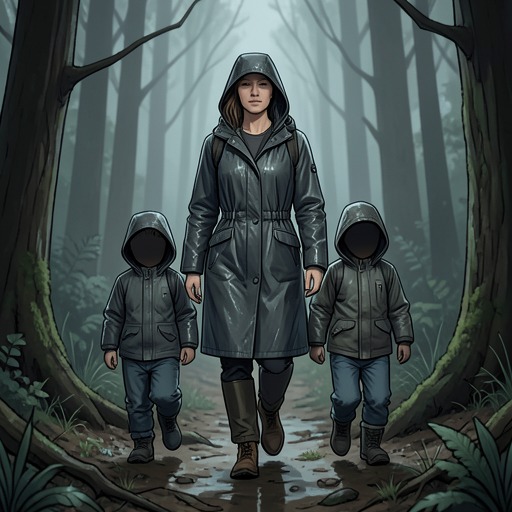
For years, Malorie had told the children that a morning might come when she would wake them and they would have to leave their home for good. She avoided calling the journey an escape, unwilling to make their ordinary days feel like something they should flee. Her warning was backed by a small pouch of food in the cupboard: it went stale, was replaced, and was replenished as a modest, recurring proof that she had a plan. When the fog arrives, preparation gives way to action. Malorie checks the Boy’s and Girl’s blindfolds, kneels before them, and tells them they will travel by rowboat along the river and must do exactly as she says. She understands, at last, that their journey out has begun.
Her care for the children is inseparable from teaching them how to act under pressure. The river journey is already physically demanding: after what feels like three hours of rowing, Malorie’s arms burn, water collects in the boat, and the Girl’s need to urinate adds another immediate task. Malorie thinks of the man they passed, but the children did not remove their blindfolds or heed the first living human voice they had heard outside one another. Their obedience is not simply a rule imposed on them; it is the result of a discipline Malorie has built because a moment of curiosity could place them in danger.
The children’s training also makes Malorie’s hidden distress audible. After injuring her shoulder, she tells them she is all right, though they know she is lying. She has taught them to attend closely enough to recognize what she tries not to reveal. She does not cry in that moment, but she had cried silently behind her blindfold; the children can detect even that. Protection, in her household, depends on listening in both directions: Malorie trains the children, and their close attention makes it harder for her to conceal her own suffering.
Malorie’s responsibilities also include the community’s ordinary work. When tension and panic build among the housemates, she redirects them toward dinner, the waste bucket, the cellar, a search of the yard for tools, feeding the birds, telephone calls, and washing bedding. The group looks at her as if she were a stranger when she speaks up, and she briefly feels embarrassed; nevertheless, the practical assignments take hold. Her authority is not introduced as a formal office. It emerges in the capacity to distinguish what needs doing and to make a frightened group move again.
Pregnancy, Birth, and the Cost of Care
Before she gives birth, Malorie repeatedly confronts the absence of the support she would normally expect. She imagines the day as something she might make quick in her mind, concentrating on the moment her water breaks and on holding the baby while trying not to consider what lies between. No doctor, medicine, friends, or family will be there. Her imagined shortcuts cannot remove those conditions, but they show how she manages anticipation: by narrowing her thoughts to the next survivable moment.
After childbirth, her body remains a serious constraint on action. Her back is tight, quick movement aggravates her pain, and ordinary tasks exhaust her; she has not had the rest a new mother needs. Yet newborn twins are in the house, and the threat has not paused. Malorie blindfolds herself and prepares a car for travel by painting its windshield black and covering the glass and bumpers with materials gathered from the cellar and garage. She undertakes the work in the street while recovering from delivery. The scene places ingenuity and physical cost side by side: survival depends on improvisation, but improvisation is demanded from a body already depleted by childbirth.
The most painful measure of Malorie’s protective resolve comes when she tries and fails to injure the Girl so the baby will never be able to see the creatures. When she feels the substance on her skin, the act becomes real, and she cannot continue. She releases the baby and backs out of the bedroom as the children cry in the darkness. The failure is decisive: Malorie cannot make protection mean deliberately harming her child, even under the logic of a world that has made sight dangerous. Her limits are not a retreat from care; they clarify the moral cost of the choices the catastrophe has forced upon her.
The birth itself takes place amid danger and disorientation. After speaking with Rick by telephone, Malorie hangs up and cries for twenty minutes. A scratching sound at the cellar door interrupts her; Victor is there, shut inside. Malorie will close the doors, reh ang the blankets, and search each part of the home with a broomstick before feeling safe enough to open her eyes. During the immediate aftermath, she steps past Tom’s body without recognizing him, mistaking it for a bag of sugar, then kneels by the well-water bucket to clean herself and the children. The altered perception is not a chosen act of disregard but a consequence of giving birth blindfolded amid the house’s collapse. She later speaks with Rick several times, but the telephone lines to the house eventually die.
The River Journey and the Choice to See
When the novel returns to Malorie’s river escape, the journey gathers earlier losses and dangers into one present-tense effort. As she approaches the channel Rick has described, she rows with memories of discovering her pregnancy, finding Shannon, arriving at the house, accepting Olympia, and surviving Gary’s arrival. She also remembers the danger of Don pulling the blankets from the windows while she was in the attic. The route is therefore more than a passage through water: each stretch of it carries the history that has made her the person who can keep rowing.
The journey does not erase the episodes that threaten her. She rows with memories of the wolf striking, the man in the boat going mad, the birds going mad, and the creature interfering with her blindfold—the protection on which her life has depended. The cloth gathers the burden of the novel’s survival rule into a single object: it has kept Malorie and the children from direct sight, yet it is also the barrier she must eventually decide whether to cross. As she enters the channel, she recognizes that she is stronger and braver than before. She has raised two children by herself in this world, and the contrast between the frightened woman at the beginning of the day and the one still rowing gives the journey its measure of change.
At the end of the passage, Malorie turns toward the channels and opens her eyes. The first difficulty is not sunlight but the colors, which make her gasp and bring a hand to her mouth. This is the novel’s crucial reversal of the closed-eye rule: after years of treating sight as an immediate danger, Malorie chooses to see in a place reached through endurance and guided by the possibility of shelter. The decision does not make the prior threat unreal, nor does it prove that every danger has passed. It marks a change in what she can risk because of where she has brought the children.
Arrival and Transformation
At the school, Malorie takes in her changed appearance in a window’s reflection. She is gaunt and bruised, her hair thin and matted, her scalp exposed in places, and a deep wound marks her swollen arm. The image contrasts starkly with the woman who once checked her flat stomach while Shannon called from another room. Yet the reflection also reveals a force that has carried her for four and a half years: the determination to survive and make a better life for the children. The contrast is not between an untouched past and a restored self. It is between the person she was and the person formed by sustained responsibility.
Once outside the house and the river, Malorie falls to her knees and removes the blindfolds from the Boy and Girl. They open their eyes, blinking and straining in the bright light. They have never seen outside the house before, and they look to Malorie for guidance; neither cries or complains. Their first encounter with the visible world is quiet and uncertain, but it unfolds in the presence of the person who has taught them how to meet danger.
Others emerge from rooms farther down the school hall. Rick places a hand on Constance’s shoulder, and the people begin walking farther into the facility, leaving Malorie and the children a moment together. The narration calls the place safer, not simply safe. That qualification preserves the novel’s caution even as the family’s immediate ordeal changes. Malorie hugs the children and thinks of Tom—his problem-solving mind and love of living—while the house and river seem to recede into almost mythical places. Her ending is therefore neither a return to the old world nor a denial of what was lost: it is a hard-won arrival in which she can hold her children and face a world beyond the blindfold.